Neurotechnology
Brain–Computer Interfaces (BCI): Uses and Configurations
A brain–computer interface measures central nervous system activity and translates it into an artificial output that can communicate, control a device, or provide feedback without relying entirely on the usual peripheral motor pathway. Modern BCIs range from communication systems for severe motor impairment to research platforms, neurofeedback systems and rehabilitation loops.
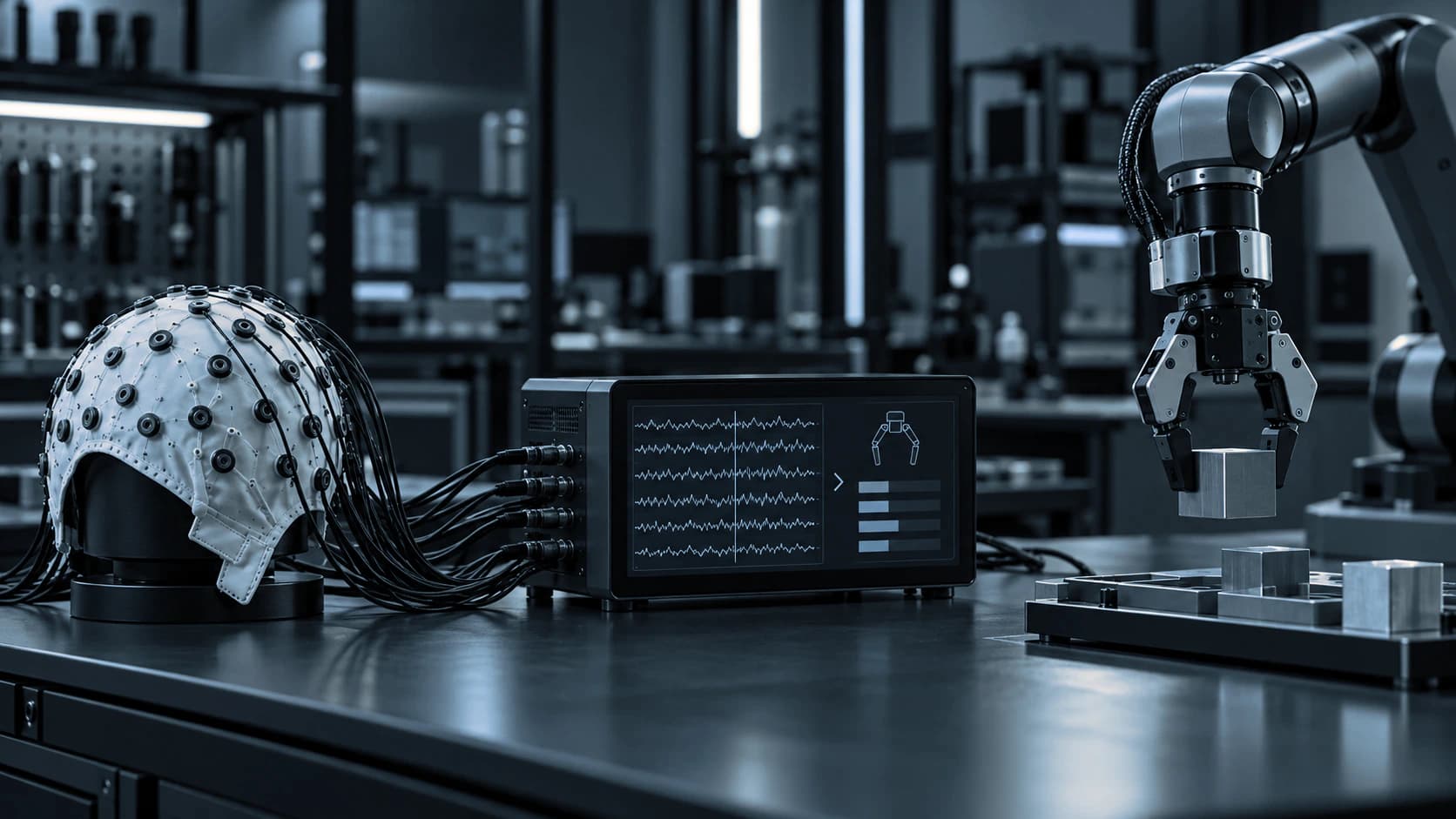
The BCI loop
A typical BCI contains signal acquisition, preprocessing, feature extraction, decoding, an output device and feedback. The user and the algorithm adapt to one another over time, which makes BCI fundamentally a closed interaction loop between neural activity, signal processing, an external output and feedback. [1,2]
Signals may come from invasive electrodes or from non-invasive modalities such as EEG and fNIRS. For most academic and translational laboratories, EEG remains the most common entry point because it combines high temporal resolution with relatively practical hardware.
Motor imagery, P300 and SSVEP
Motor imagery means mentally rehearsing a movement without actually performing it. Motor-imagery BCIs decode the associated changes in sensorimotor rhythms—rhythmic EEG activity over sensorimotor cortex that changes during real or imagined movement. P300 is a positive event-related EEG potential that is typically strongest around 300 milliseconds after a task-relevant or infrequent stimulus. P300-based BCIs use this response to infer which item or event the user is attending to. A steady-state visual evoked potential (SSVEP) is a rhythmic EEG response that follows the frequency of a periodically flickering visual stimulus. SSVEP-based BCIs identify which stimulus the user is looking at from the frequency pattern in the EEG. [3]
These paradigms differ in training requirements, visual load, number of possible commands, speed and suitability for different users. The right paradigm depends on whether the goal is communication, device control, feedback or rehabilitation.
Typical BCI use cases
BCI systems are designed around an output goal: communication, control, feedback or rehabilitation. The signal and paradigm are selected to match that goal and the abilities of the intended user.
- Communication and spelling interfaces
- Cursor, device or assistive control
- Motor rehabilitation with robotics or functional electrical stimulation
- Neurofeedback and adaptive training
- Research on real-time brain-state decoding
fNIRS and hybrid BCI systems
Functional near-infrared spectroscopy (fNIRS) can classify task-related changes in cortical haemodynamics. Its response is slower than EEG because it depends on neurovascular coupling—the process by which local neural activity is followed by changes in blood flow and oxygenation. Hybrid EEG–fNIRS BCIs combine fast electrical and slower haemodynamic information. [4,5]
Hybridization can add complementary features or improve robustness in some settings, but it also increases hardware, synchronization and analysis complexity.
BCI in neurorehabilitation
In BCI-based rehabilitation, detected motor intention or motor imagery can be coupled to visual feedback, a robotic device or functional electrical stimulation. Systematic reviews and meta-analyses indicate that such approaches can improve upper-limb motor outcomes in some post-stroke populations, particularly as part of structured rehabilitation programs. [6,7]
The literature nevertheless varies substantially in protocol, training dose, feedback mode and participant selection. The clinical role of BCI rehabilitation should therefore be evaluated for the specific use case and evidence base rather than generalized across populations.
Common BCI configurations
A BCI configuration combines a signal source, paradigm, real-time processing layer, output device and feedback. Non-invasive systems most often use EEG, fNIRS or a hybrid of the two.
- EEG motor-imagery BCI
- P300 or SSVEP communication/control BCI
- fNIRS BCI
- Hybrid EEG–fNIRS BCI
- BCI linked to VR, robotics or functional electrical stimulation
Evidence
References and further reading
- 1.Wolpaw JR, Millán JDR, Ramsey NF. Brain-computer interfaces: Definitions and principles. Handbook of Clinical Neurology, 2020.
- 2.Wolpaw JR et al. Brain-computer interfaces for communication and control. Clinical Neurophysiology, 2002.
- 3.Paradigms and methods of noninvasive brain-computer interfaces in motor or communication assistance and rehabilitation: a systematic review, 2025.
- 4.Naseer N, Hong KS. fNIRS-based brain-computer interfaces: a review. Frontiers in Human Neuroscience, 2015.
- 5.fNIRS-EEG BCIs for Motor Rehabilitation: A Review, 2023.
- 6.Jin W et al. Electroencephalogram-based adaptive closed-loop brain-computer interface in neurorehabilitation: a review. Frontiers in Computational Neuroscience, 2024.
- 7.Brain-computer interfaces in poststroke rehabilitation: a meta-analysis of randomized clinical trials, 2026.
Next step
Interested in this technology?
Contact me to discuss available options and suitable configurations.
Contact me about this technologyContinue
Related articles
Neurotechnology
Electroencephalography (EEG)
Electroencephalography records voltage differences at the scalp that reflect the summed electrical activity of large neuronal populations. Its defining advantage is temporal resolution: EEG can follow brain dynamics on the scale of milliseconds, which makes it central to clini…
Neurotechnology
Functional Near-Infrared Spectroscopy (fNIRS)
Functional near-infrared spectroscopy is a non-invasive optical method that estimates relative changes in oxygenated and deoxygenated haemoglobin using near-infrared light. Portable systems make it possible to study cortical haemodynamics in settings where MRI is impractical o…
Neurotechnology
Transcranial Electrical Stimulation (tES/tDCS)
Transcranial electrical stimulation (tES) is a family of non-invasive methods that apply low-intensity electrical current through scalp electrodes. tDCS uses direct current, while other variants include alternating current (tACS), random-noise stimulation (tRNS) and newer patt…