Neurotechnology
Transcranial Electrical Stimulation (tES/tDCS): Uses and Configurations
Transcranial electrical stimulation (tES) is a family of non-invasive methods that apply low-intensity electrical current through scalp electrodes. tDCS uses direct current, while other variants include alternating current (tACS), random-noise stimulation (tRNS) and newer patterned approaches. These techniques are widely used in neuroscience research and are being studied across neurological and psychiatric applications.
Modulation rather than direct triggering
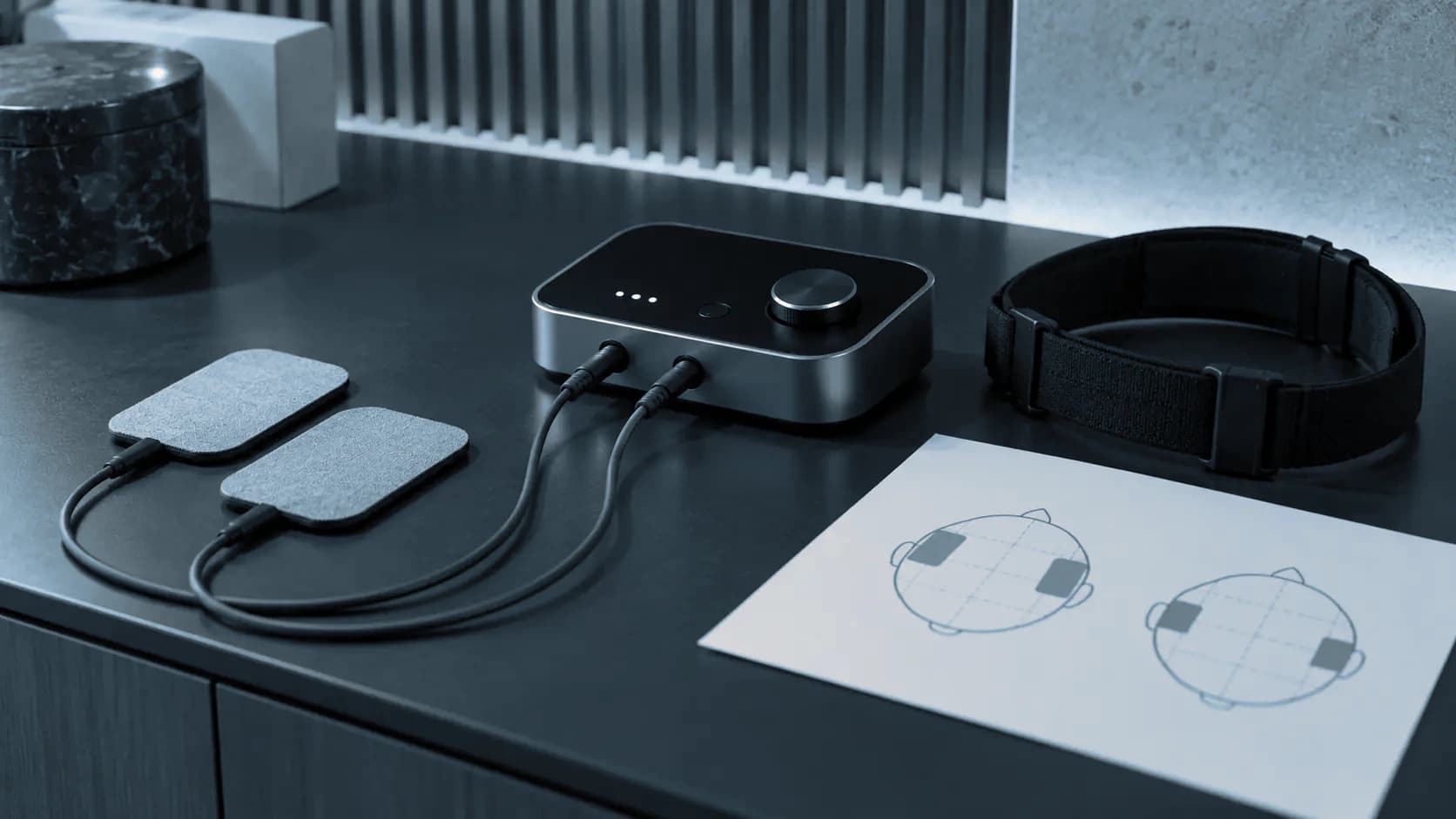
At conventional intensities, tDCS generally changes the electrical environment of cortical tissue rather than directly forcing neurons to fire in the way that a suprathreshold TMS pulse can. The resulting effects depend on current direction, electrode montage—the number, size, polarity and placement of the stimulation electrodes—, intensity, duration, anatomy and the state of the stimulated network.
Simple descriptions such as “anodal excites and cathodal inhibits” can be useful introductory shorthand but are not universal rules across brain regions, tasks and protocols.
tES is a family of approaches
tDCS delivers a relatively constant current. Transcranial alternating current stimulation (tACS) applies current that changes direction rhythmically and is often studied in relation to neural oscillations. Transcranial random-noise stimulation (tRNS) applies rapidly varying current across a range of frequencies. High-definition transcranial electrical stimulation (HD-tES) uses several smaller electrodes to shape the electric field more focally than conventional large-pad montages. [1,3–5]
Computational electric-field modelling, which estimates how stimulation current is distributed through an individual head model, is increasingly used to estimate where current is likely to flow, especially when targeting or comparing montages.
Typical tES use cases
tES is widely used as an experimental neuromodulation method and is also studied in rehabilitation and clinical research. Interpretation should remain protocol- and indication-specific.
- Motor and cognitive neuroscience
- Plasticity and learning studies
- Neurorehabilitation research
- Clinical trials of indication-specific protocols
- Rhythm-oriented tACS and high-definition stimulation research
Safety is well studied, but protocol still matters
Recent expert guidance covering hundreds of thousands of low-intensity tES sessions reports a strong safety record when established procedures are followed; mild transient sensations such as tingling, burning, headache or fatigue are common. [1]
That does not make unsupervised stimulation automatically appropriate. Screening, equipment quality, skin preparation, current density, montage, duration, concurrent treatments and clinical context still matter.
Clinical evidence remains uneven
Evidence-based tDCS recommendations differ by indication and montage, and many proposed cognitive or clinical applications remain investigational. [2] High-definition tDCS is scientifically attractive because of improved focality, but clinical evidence is still less mature than the basic technical promise. [3,4]
For a laboratory or clinic, the right question is therefore not simply whether a device can deliver tDCS, but which protocols are supported for the intended use and whether the system allows controlled, reproducible stimulation.
Common tES configurations
tES platforms range from conventional two-electrode stimulation to multi-electrode high-definition systems. Research systems may support several waveform families, sham control and electric-field modelling.
- Conventional tDCS pad montages
- tACS and tRNS waveforms
- High-definition multi-electrode tES
- Multi-channel stimulation
- Sham/blinding and electric-field modelling workflows
Evidence
References and further reading
- 1.Low intensity transcranial electric stimulation: Safety, ethical, legal, regulatory and application guidelines (2017–2025 update), 2026.
- 2.Lefaucheur JP et al. Evidence-based guidelines on the therapeutic use of transcranial direct current stimulation. Clinical Neurophysiology, 2017.
- 3.Parlikar R et al. High-definition transcranial direct current stimulation: a systematic review on neuropsychiatric disorders. Asian Journal of Psychiatry, 2021.
- 4.Tedla JS et al. High-definition transcranial direct current stimulation and cognitive function: a systematic review. Cerebral Cortex, 2023.
- 5.Transcranial direct current stimulation: a review of electrode characteristics and materials. Medical Engineering & Physics, 2020.
Next step
Interested in this technology?
Contact me to discuss available options and suitable configurations.
Contact me about this technologyContinue
Related articles
Neurotechnology
Transcranial Magnetic Stimulation (TMS)
Transcranial magnetic stimulation uses a rapidly changing magnetic field generated by a coil outside the head to induce an electric field in cortical tissue. Depending on protocol and target, TMS can probe cortical function, map motor or language systems, measure excitability,…
Neurotechnology
Brain–Computer Interfaces (BCI)
A brain–computer interface measures central nervous system activity and translates it into an artificial output that can communicate, control a device, or provide feedback without relying entirely on the usual peripheral motor pathway. Modern BCIs range from communication syst…
Neurotechnology
Neurofeedback and Biofeedback
Biofeedback measures a physiological signal and presents information about that signal to the participant in real time, with the aim of supporting learned self-regulation. Neurofeedback is a form of biofeedback in which the feedback is derived from brain activity, most often E…