Neurotechnology
Neurofeedback and Biofeedback: Uses and Configurations
Biofeedback measures a physiological signal and presents information about that signal to the participant in real time, with the aim of supporting learned self-regulation. Neurofeedback is a form of biofeedback in which the feedback is derived from brain activity, most often EEG or functional MRI.
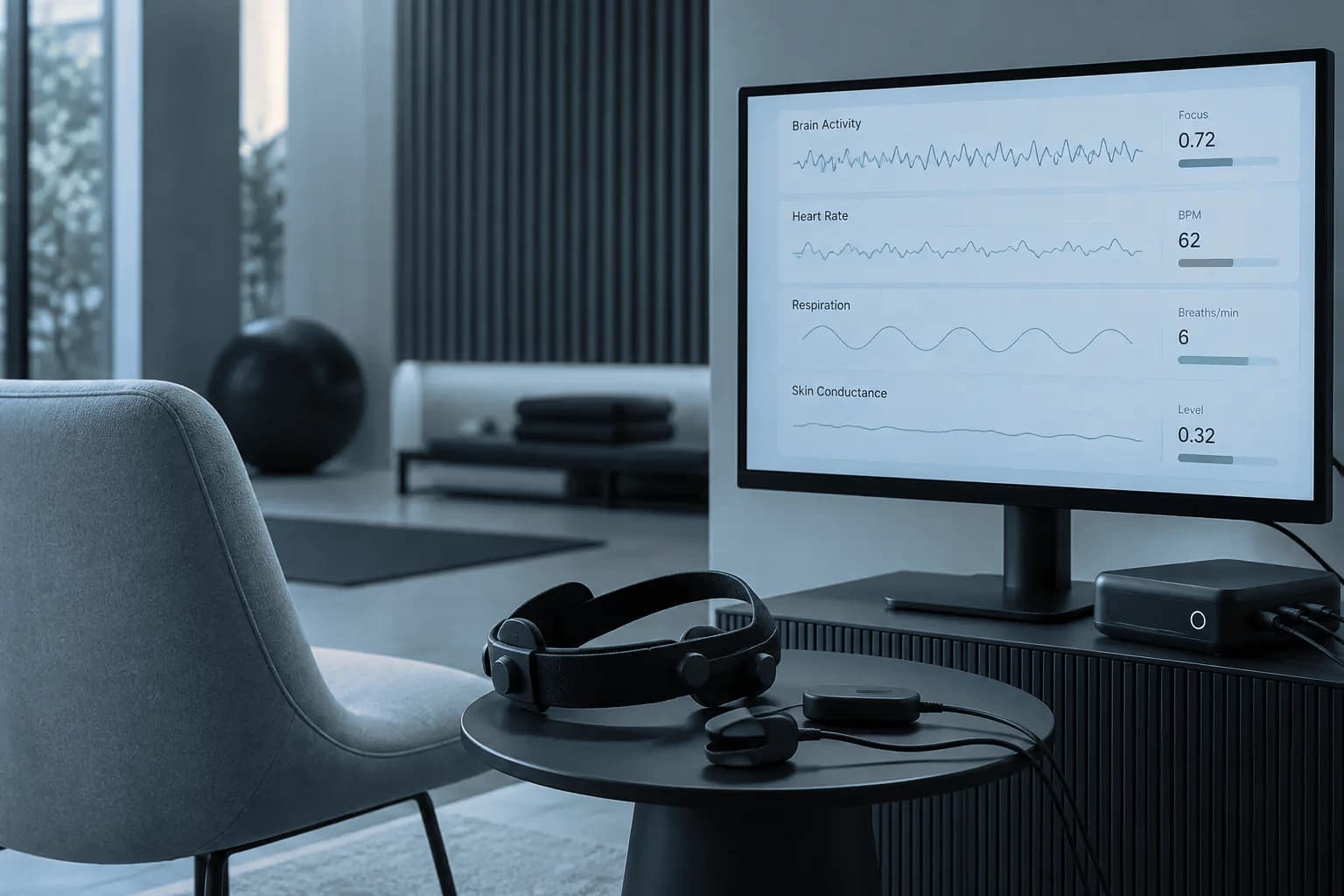
Signals used for feedback
Biofeedback systems may use heart rate, heart-rate variability (HRV), the beat-to-beat variation in the interval between successive heartbeats, respiration, electrodermal activity (EDA), changes in skin conductance driven mainly by sweat-gland activity, muscle activity or skin temperature. EEG neurofeedback may use spectral power, the strength of EEG activity within a defined frequency band, sensorimotor rhythms or other predefined electrophysiological features.
Feedback can be visual, auditory, game-based or presented in VR. The scientific value of the system depends on whether the target physiological variable is clearly defined and measured reliably in real time. [1]
Neurofeedback as a closed-loop training system
During neurofeedback, the measured signal is processed continuously and translated into external feedback. The participant can then adjust strategy or state while the system updates the feedback. Signal quality, processing algorithms, feedback delay and learning design all influence the training loop.
The CRED-nf consensus recommends transparent reporting of controls, preregistration, signal processing, neurophysiological outcomes and behavioural outcomes in neurofeedback research. [2]
Typical use cases
Feedback systems are selected according to the physiological variable that is meant to be learned or regulated, and according to whether the goal is research, rehabilitation, clinical training or performance.
- EEG neurofeedback
- HRV and respiration biofeedback
- EMG biofeedback for motor rehabilitation
- EDA and autonomic self-regulation research
- Multimodal or VR-based feedback studies
Clinical efficacy is protocol- and indication-specific
Neurofeedback has been studied across neurological and psychiatric conditions, but the quality of evidence and effect sizes vary by population, target signal, control condition and training protocol. [3]
HRV biofeedback has been evaluated in systematic reviews and meta-analyses for stress, anxiety and physiological self-regulation. [4,5] These findings still need to be interpreted in relation to the specific protocol and comparison condition.
Research system transparency
For research use, access to raw signals, filters, thresholds, feedback latency and data export is valuable. EEG neurofeedback also depends on electrode contact and artefact handling; HRV biofeedback depends on reliable cardiac and respiratory signals.
A system intended for research should make enough of this processing visible to reproduce the protocol and understand what the participant is actually being trained to change.
Common feedback configurations
Configurations differ by signal, number of channels, feedback modality and transparency of real-time processing. Research systems generally benefit from raw-data access and configurable algorithms.
- Single-signal HRV, respiration or EDA biofeedback
- EMG biofeedback
- Few-channel or multichannel EEG neurofeedback
- Visual, auditory, game or VR feedback
- Multimodal research systems with raw-data export
Evidence
References and further reading
- 1.Sitaram R et al. Closed-loop brain training: the science of neurofeedback. Nature Reviews Neuroscience, 2017.
- 2.Ros T et al. Consensus on the reporting and experimental design of clinical and cognitive-behavioural neurofeedback studies (CRED-nf). Brain, 2020.
- 3.Ribeiro TF et al. Clinical applications of neurofeedback based on sensorimotor rhythm: a systematic review and meta-analysis. Frontiers in Neuroscience, 2023.
- 4.Goessl VC, Curtiss JE, Hofmann SG. The effect of heart rate variability biofeedback training on stress and anxiety: a meta-analysis. Psychological Medicine, 2017.
- 5.Lehrer P et al. Heart Rate Variability Biofeedback Improves Emotional and Physical Health and Performance: A Systematic Review and Meta Analysis. Applied Psychophysiology and Biofeedback, 2020.
Next step
Interested in this technology?
Contact me to discuss available options and suitable configurations.
Contact me about this technologyContinue
Related articles
Neurotechnology
Psychophysiological Recording
Psychophysiology studies relationships between psychological processes and measurable physiological changes. Modern systems can record cardiac activity, electrodermal activity, respiration, muscle activity, temperature and, when relevant, brain signals in synchronized experime…
Neurotechnology
Electroencephalography (EEG)
Electroencephalography records voltage differences at the scalp that reflect the summed electrical activity of large neuronal populations. Its defining advantage is temporal resolution: EEG can follow brain dynamics on the scale of milliseconds, which makes it central to clini…
Neurotechnology
Brain–Computer Interfaces (BCI)
A brain–computer interface measures central nervous system activity and translates it into an artificial output that can communicate, control a device, or provide feedback without relying entirely on the usual peripheral motor pathway. Modern BCIs range from communication syst…