Neurotechnology
Psychophysiological Recording: Signals, Uses and Configurations
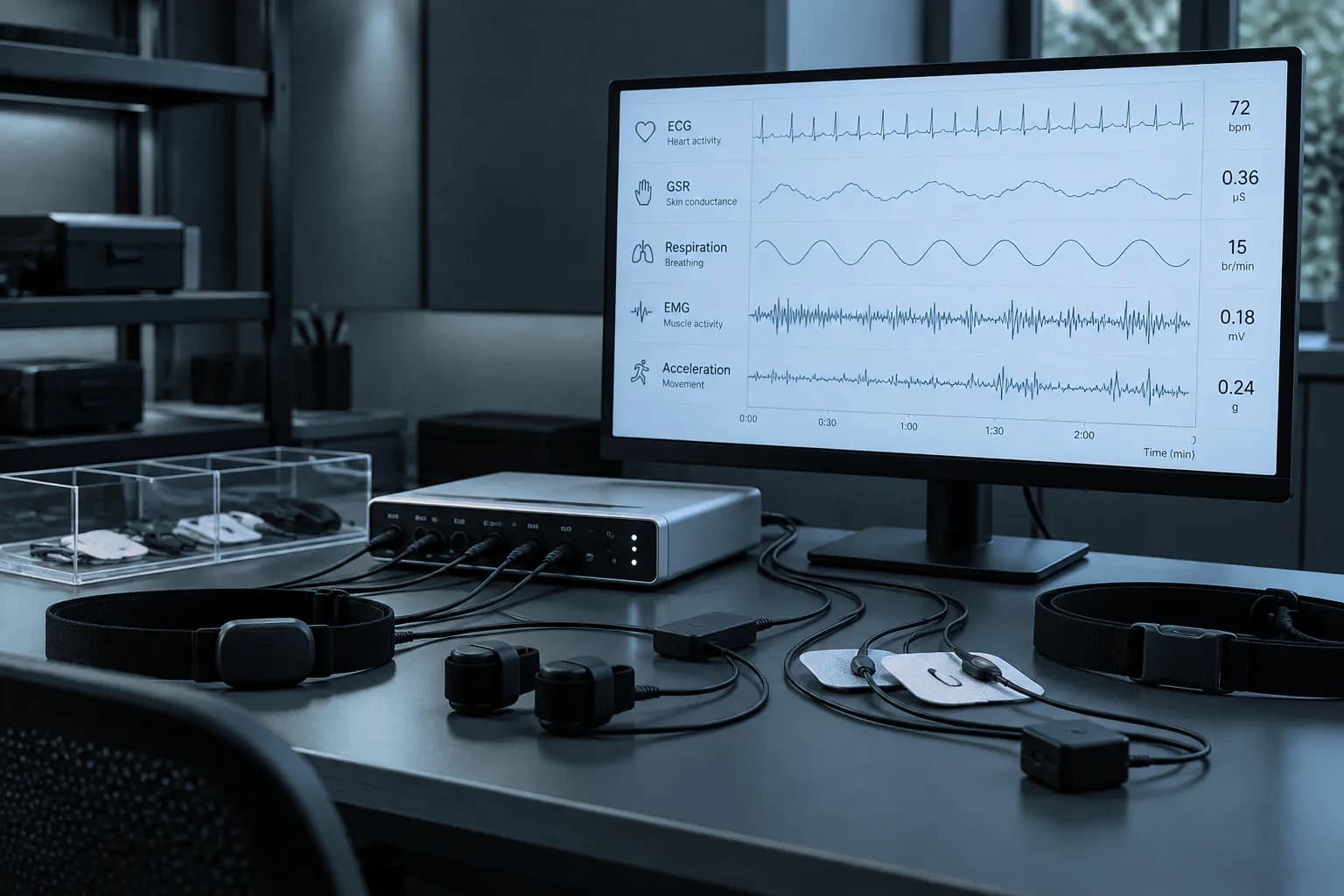
Psychophysiology studies relationships between psychological processes and measurable physiological changes. Modern systems can record cardiac activity, electrodermal activity, respiration, muscle activity, temperature and, when relevant, brain signals in synchronized experiments.
ECG and heart-rate variability
Electrocardiography (ECG) records the electrical activity of the heart. Timing differences between successive cardiac cycles can be used to derive heart rate and heart-rate variability (HRV), which describes variation in the time interval between successive heartbeats.
HRV interpretation depends on recording duration, signal quality, respiration, posture, physical activity and the chosen time- or frequency-domain measures. Contemporary reporting guidance therefore emphasizes detailed documentation of acquisition conditions and analysis steps. [1]
Electrodermal activity
Electrodermal activity (EDA) reflects changes in skin conductance that are driven mainly by sympathetic control of sweat glands. The term galvanic skin response (GSR) is also widely used in this area. [2]
EDA is commonly decomposed into slower tonic activity, meaning the background skin-conductance level, and faster phasic responses, meaning shorter event-related changes. These signals are sensitive to general physiological arousal, while inference about a specific emotion or psychological state requires experimental context and complementary measures.
Typical use cases
Psychophysiological recording is useful when a study needs objective measures of autonomic, cardiac, respiratory or muscular change alongside behaviour or self-report.
- Stress, emotion and arousal research
- Attention, workload and human-factors studies
- Pain and autonomic research
- Movement and rehabilitation
- Multimodal neuroscience with EEG or eye tracking
Respiration and electromyography
Respiratory dynamics can be measured using chest or abdominal belts, airflow sensors, pressure systems or gas analysis. Respiratory rate and depth are especially important when interpreting HRV and autonomic physiology. [3]
Electromyography (EMG) records electrical activity from muscle. Surface electromyography (surface EMG), in which electrodes on the skin measure electrical activity generated by underlying muscle, is widely used in movement science, rehabilitation, biomechanics and facial psychophysiology. Electrode placement, cross-talk, movement artefacts and normalization require standardized methodology. [4,5]
Why multimodal recording is useful
Synchronized acquisition makes it possible to align EEG, ECG, EDA, respiration, EMG, behavioural responses and experimental events on the same timeline. This can show how multiple systems change during the same task or stimulus.
The quality of a multimodal experiment depends not only on individual sensors but also on shared timing, signal-quality control and a prespecified analysis strategy.
Common recording configurations
A psychophysiology setup can be built around one signal or around a synchronized sensor suite. The configuration should follow the scientific question and required mobility.
- Compact heart-rate/EDA setups
- ECG + respiration + EDA laboratory systems
- EMG-focused movement or facial setups
- Wireless/mobile physiology
- Full multimodal systems synchronized with EEG, eye tracking or tasks
Evidence
References and further reading
- 1.Quigley KS et al. Publication guidelines for human heart rate and heart rate variability studies in psychophysiology—Part 1. Psychophysiology, 2024.
- 2.Boucsein W et al. Publication recommendations for electrodermal measurements. Psychophysiology, 2012.
- 3.Ritz T et al. Guidelines for mechanical lung function measurements in psychophysiology. Psychophysiology, 2002.
- 4.Merletti R, Cerone GL. Surface EMG detection, conditioning and pre-processing: Best practices. Journal of Electromyography and Kinesiology, 2020.
- 5.van Boxtel A, van der Graaff J. Standardization of facial electromyographic responses. Biological Psychology, 2024.
Next step
Interested in this technology?
Contact me to discuss available options and suitable configurations.
Contact me about this technologyContinue
Related articles
Neurotechnology
Neurofeedback and Biofeedback
Biofeedback measures a physiological signal and presents information about that signal to the participant in real time, with the aim of supporting learned self-regulation. Neurofeedback is a form of biofeedback in which the feedback is derived from brain activity, most often E…
Neurotechnology
Experimental Response and Synchronization Systems
Neuroscience experiments need more than biological recording: they also need an accurate account of when each stimulus appeared, when the participant responded, and how those events align with signals collected by different devices. Response hardware, event markers and synchro…
Neurotechnology
Electroencephalography (EEG)
Electroencephalography records voltage differences at the scalp that reflect the summed electrical activity of large neuronal populations. Its defining advantage is temporal resolution: EEG can follow brain dynamics on the scale of milliseconds, which makes it central to clini…