Neurotechnology
Experimental Response and Synchronization Systems
Neuroscience experiments need more than biological recording: they also need an accurate account of when each stimulus appeared, when the participant responded, and how those events align with signals collected by different devices. Response hardware, event markers and synchronization infrastructure solve this timing problem.
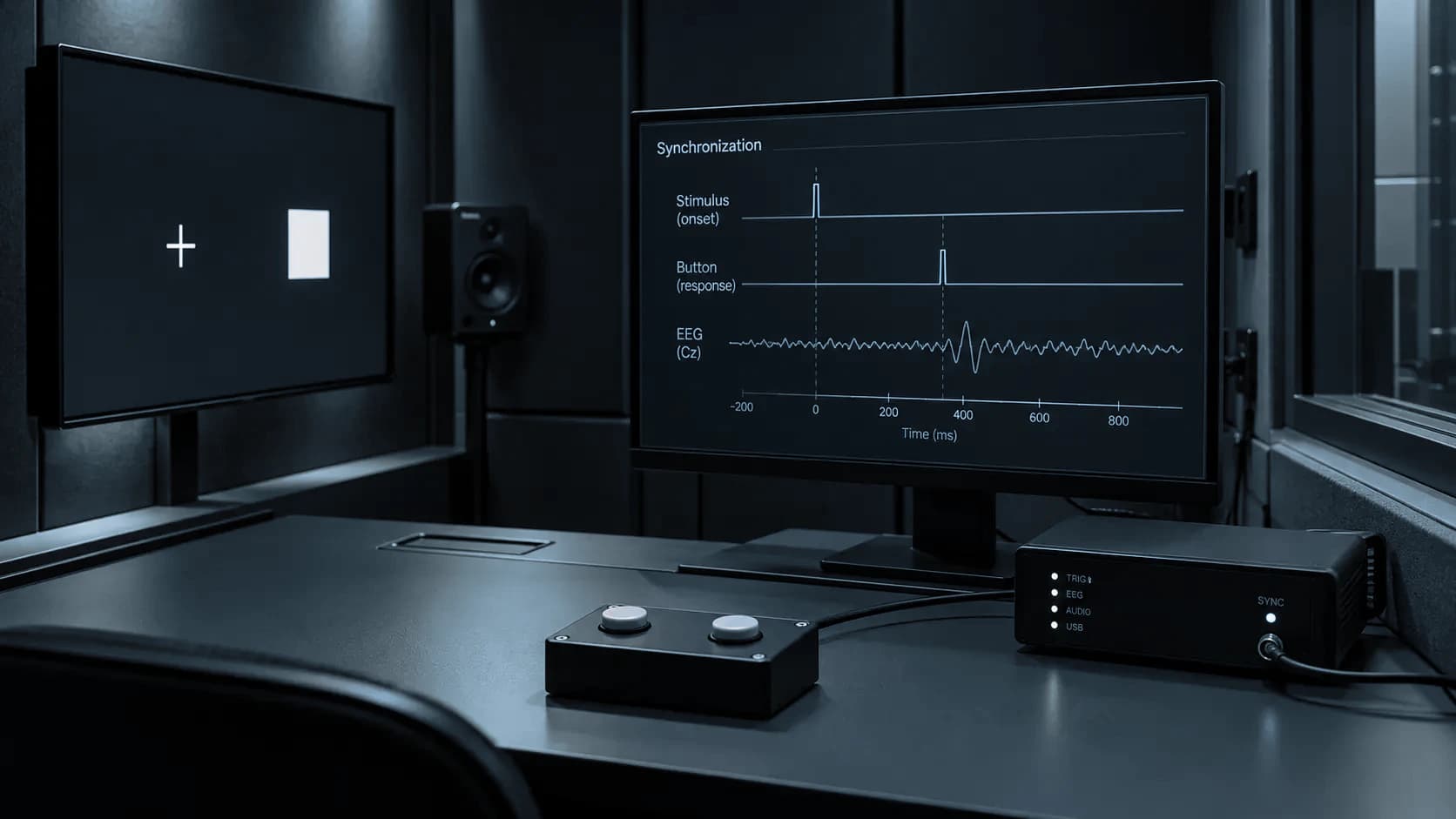
The experiment as one timing system
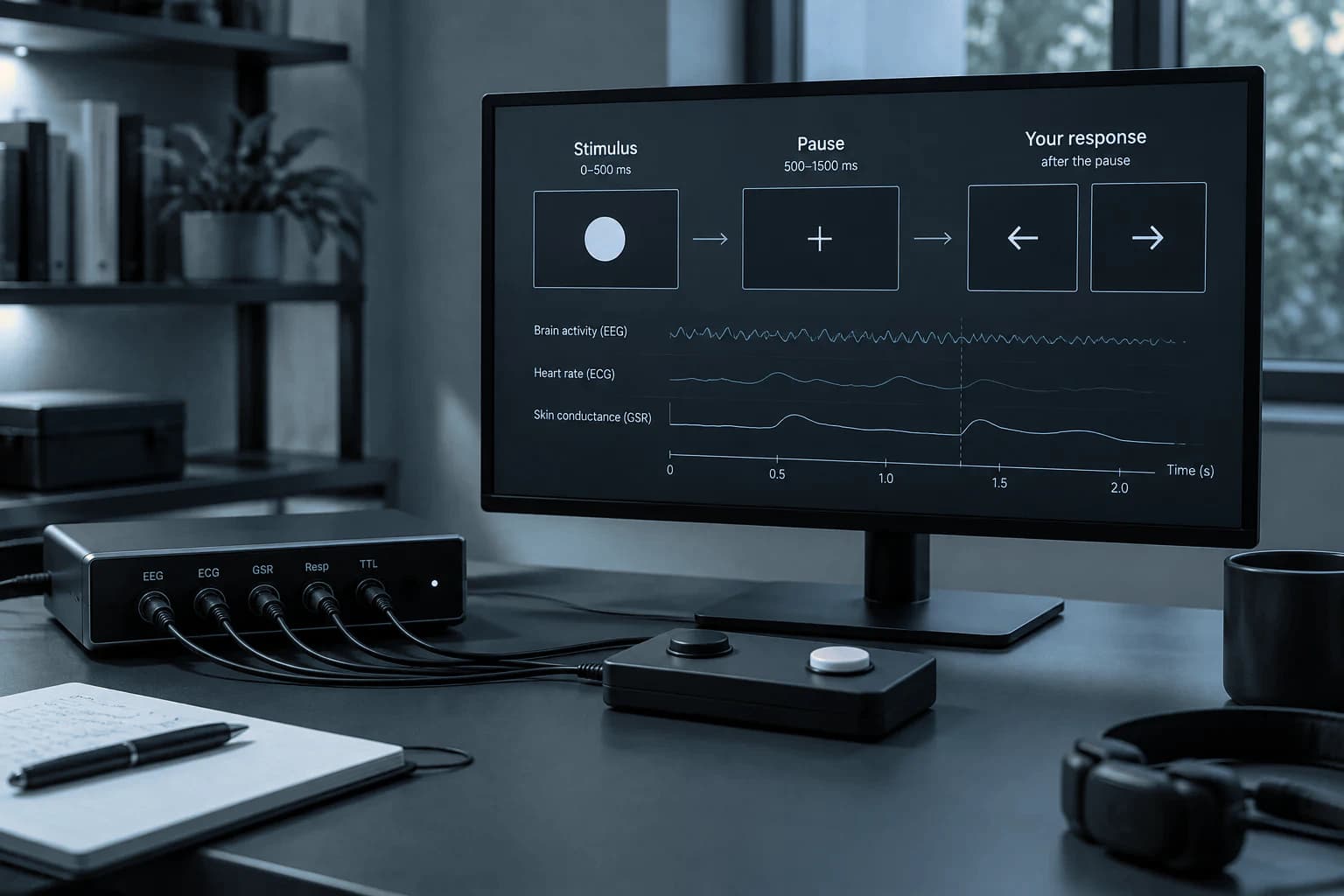
In an EEG experiment, a visual stimulus may be presented by one computer, the participant’s response recorded by a separate response device, and EEG, eye tracking or physiology acquired by different systems. Each device has its own clock, buffering and transport path.
A reliable design therefore needs either a common timing reference or measured and documented latency for each component.
The role of response devices
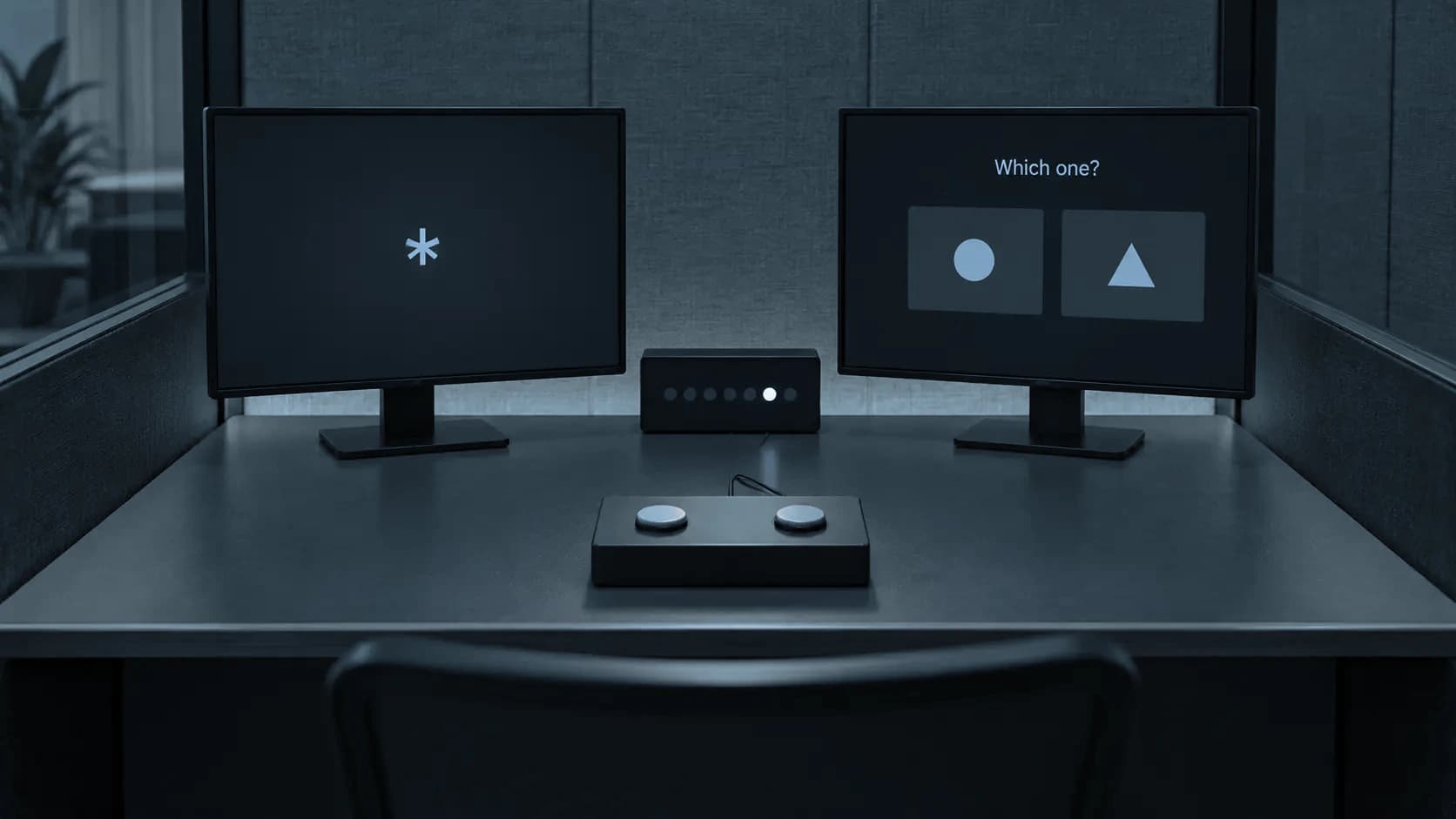
Dedicated response pads can provide predictable measured latency—the delay between a physical event and the time at which the system records it—, multiple buttons, external event markers and, in some models, compatibility with MRI environments.
Evaluation should consider not only average speed but also latency variability, the way event timing is marked and how the device integrates with the rest of the data stream.
Typical use cases
Timing infrastructure becomes essential whenever behavioural events must be aligned with physiological or neural data at known latency.
- Reaction-time and decision tasks
- ERP and EEG experiments
- MRI/fMRI-compatible response collection
- Eye-tracking and multimodal studies
- Closed-loop and real-time experiments
Event markers and stream synchronization
A hardware trigger is a digital event marker sent at a precisely defined moment—for example when a stimulus appears or a button is pressed. These markers can be written directly into an EEG or physiology acquisition system. Software synchronization layers can align timestamped streams from multiple devices over a network.
Lab Streaming Layer (LSL) is an open software framework that timestamps data streams from different devices, estimates differences between their clocks and aligns the streams on a common time base. [1] Display refresh, audio latency, USB buffering and device firmware can still require independent validation.
Synchronization is designed before data collection
Stimulus software, response devices, triggers, sampling rates and data export should be tested as a complete system before participants are recorded. Experimental software such as PsychoPy supports controlled stimulus and behavioural task construction, while hardware and software synchronization methods connect those events to physiological recordings. [2]
In multi-device laboratories, interoperability, documented latencies and empirical timing validation are core parts of data quality.
Common timing configurations
Timing can be implemented with dedicated response devices, hardware event triggers, network-based synchronization, or combinations of these methods. Validation devices can be added when display or audio onset must be measured directly.
- Dedicated response pads or button boxes
- TTL/event-trigger interfaces
- Photodiode or audio-onset validation
- Lab Streaming Layer or other synchronized network streams
- MRI-compatible response and trigger hardware
Evidence
References and further reading
- 1.Kothe C et al. The Lab Streaming Layer for synchronized multimodal recording. Imaging Neuroscience, 2025.
- 2.Peirce J et al. PsychoPy2: Experiments in behavior made easy. Behavior Research Methods, 2019.
- 3.Peltola ME et al. Routine and sleep EEG: Minimum recording standards of the IFCN and ILAE. Clinical Neurophysiology, 2023.
- 4.Standards of instrumentation of EMG. Clinical Neurophysiology, 2020.
Next step
Interested in this technology?
Contact me to discuss available options and suitable configurations.
Contact me about this technologyContinue
Related articles
Neurotechnology
Electroencephalography (EEG)
Electroencephalography records voltage differences at the scalp that reflect the summed electrical activity of large neuronal populations. Its defining advantage is temporal resolution: EEG can follow brain dynamics on the scale of milliseconds, which makes it central to clini…
Neurotechnology
Functional Near-Infrared Spectroscopy (fNIRS)
Functional near-infrared spectroscopy is a non-invasive optical method that estimates relative changes in oxygenated and deoxygenated haemoglobin using near-infrared light. Portable systems make it possible to study cortical haemodynamics in settings where MRI is impractical o…
Neurotechnology
Psychophysiological Recording
Psychophysiology studies relationships between psychological processes and measurable physiological changes. Modern systems can record cardiac activity, electrodermal activity, respiration, muscle activity, temperature and, when relevant, brain signals in synchronized experime…