Neurotechnology
Transcranial Magnetic Stimulation (TMS): Uses and Configurations
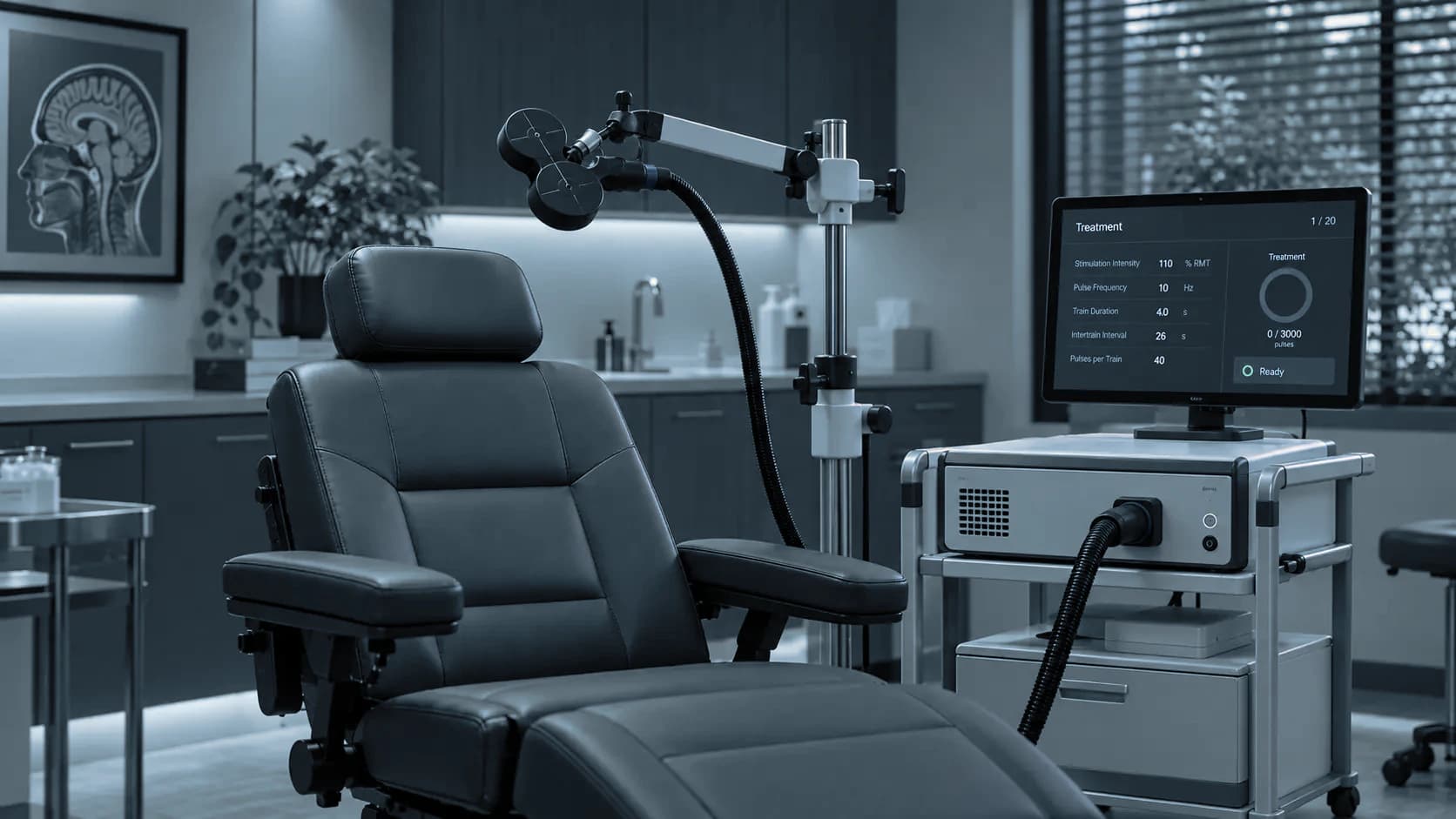
Transcranial magnetic stimulation uses a rapidly changing magnetic field generated by a coil outside the head to induce an electric field in cortical tissue. Depending on protocol and target, TMS can probe cortical function, map motor or language systems, measure excitability, or deliver repeated stimulation intended to modify network activity.
Single-pulse, paired-pulse and repetitive TMS
A single TMS pulse can transiently perturb cortical activity and, over motor cortex, produce measurable motor-evoked potentials (MEPs)—electrical responses recorded from a muscle after stimulation of its motor-cortex representation. Paired-pulse TMS delivers two pulses separated by a controlled interval and is used to probe aspects of cortical excitability and inhibition. Repetitive TMS (rTMS) and patterned protocols such as theta-burst stimulation (TBS), a patterned protocol that delivers short high-frequency bursts in a repeated rhythm deliver trains of pulses and are used in research and in selected therapeutic applications.
The biological effect is not determined by frequency alone. Coil geometry, intensity, target, pulse pattern, number of sessions and individual anatomy all matter.
Clinical evidence is indication-specific
Evidence-based guidelines support rTMS for some neurological and psychiatric indications, but efficacy varies substantially by condition and protocol. Strong evidence for one target or disorder should not be generalized to another. [1,2]
TMS also requires formal safety screening, trained personnel and attention to seizure risk, hearing protection, implants and other contraindications or precautions. [1]
Typical TMS use cases
TMS can be used as a measurement, perturbation, mapping or therapeutic tool. The protocol determines which of these roles the system serves.
- Motor threshold and cortical excitability
- Motor, language or functional mapping
- Causal cognitive-neuroscience experiments
- Therapeutic rTMS protocols for supported indications
- TMS–EEG and connectivity research
TMS–EEG measures the cortical response to perturbation
Combining TMS with EEG allows researchers to stimulate a cortical region and record the resulting electrical response across the scalp. This can be powerful for studying effective connectivity, meaning the directed influence that activity in one brain region can exert on another, excitability and state-dependent responses. [3]
TMS–EEG is technically demanding because the pulse creates large electromagnetic, auditory and somatosensory artefacts. High-quality work therefore depends on specialized amplifiers, careful experimental control, preprocessing and, often, neuronavigation.
Common TMS configurations
TMS platforms are configured around pulse protocol, coil geometry, targeting and accompanying measurements. Research setups often add neuronavigation, EMG or EEG.
- Single- and paired-pulse TMS
- Repetitive TMS and theta-burst protocols
- Different coil geometries for different targets
- MRI-guided or landmark-based neuronavigation
- TMS–EMG and TMS–EEG systems
Evidence
References and further reading
- 1.Rossi S et al. Safety and recommendations for TMS use in healthy subjects and patient populations: Expert Guidelines. Clinical Neurophysiology, 2021.
- 2.Lefaucheur JP et al. Evidence-based guidelines on the therapeutic use of repetitive TMS: an update. Clinical Neurophysiology, 2020.
- 3.Lioumis P, Rosanova M. The role of neuronavigation in TMS-EEG studies. Journal of Neuroscience Methods, 2022.
- 4.Herwig U et al. The navigation of transcranial magnetic stimulation. Psychiatry Research: Neuroimaging, 2001.
- 5.Accuracy and precision of navigated transcranial magnetic stimulation. Journal of Neural Engineering, 2023.
Next step
Interested in this technology?
Contact me to discuss available options and suitable configurations.
Contact me about this technologyContinue
Related articles
Neurotechnology
Transcranial Electrical Stimulation (tES/tDCS)
Transcranial electrical stimulation (tES) is a family of non-invasive methods that apply low-intensity electrical current through scalp electrodes. tDCS uses direct current, while other variants include alternating current (tACS), random-noise stimulation (tRNS) and newer patt…
Neurotechnology
Electroencephalography (EEG)
Electroencephalography records voltage differences at the scalp that reflect the summed electrical activity of large neuronal populations. Its defining advantage is temporal resolution: EEG can follow brain dynamics on the scale of milliseconds, which makes it central to clini…
Neurotechnology
Experimental Response and Synchronization Systems
Neuroscience experiments need more than biological recording: they also need an accurate account of when each stimulus appeared, when the participant responded, and how those events align with signals collected by different devices. Response hardware, event markers and synchro…