Neurotechnology
Neurotechnology: Methods, Uses and System Types
Neurotechnology is an umbrella term for tools that measure nervous-system activity, translate neural signals into useful outputs, provide feedback, or influence neural activity. The field ranges from established clinical technologies such as EEG and TMS to rapidly developing research systems such as wearable fNIRS, hybrid brain–computer interfaces, and closed-loop stimulation, in which measured activity is used to adjust feedback or stimulation in real time.
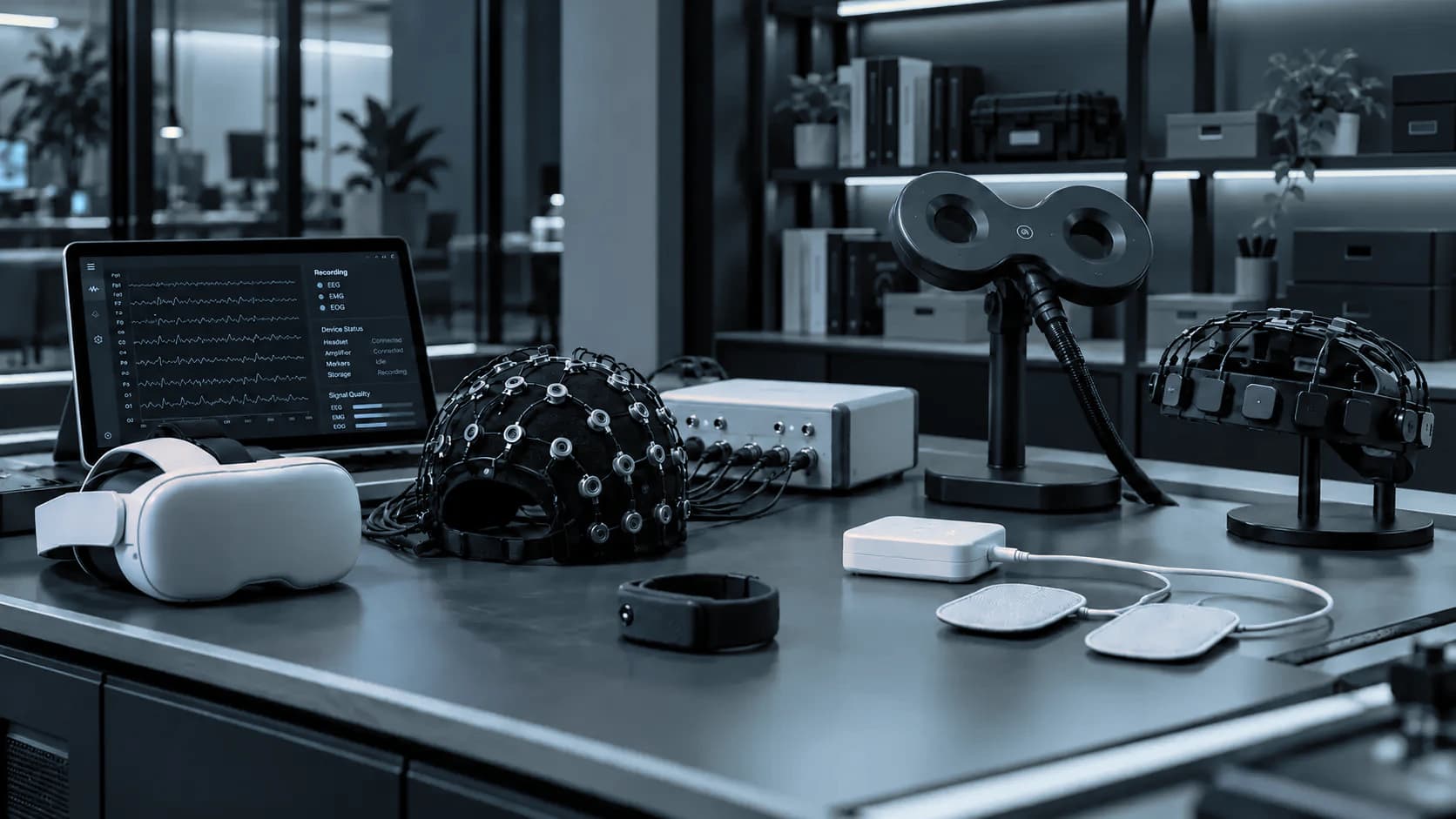
A field, not a single device
Neurotechnology includes several different families of tools. Recording technologies include electroencephalography (EEG), which measures electrical activity from the scalp, and functional near-infrared spectroscopy (fNIRS), which estimates cortical changes in blood oxygenation and blood flow. Brain–computer interfaces (BCIs) translate measured nervous-system activity into commands, communication or feedback for an external system. Stimulation technologies include transcranial magnetic stimulation (TMS), which uses brief magnetic fields to induce electrical currents in cortical tissue, and transcranial electrical stimulation (tES), which applies low-intensity current through scalp electrodes. Biofeedback and neurofeedback return measured signals to the user in real time.
These families often overlap. A modern experiment may combine EEG, stimulation, behavioural responses and autonomic physiology in one synchronized system. Selection is therefore best guided by the scientific or clinical question, the signal of interest and the intended intervention.
- EEG and electrophysiology: fast electrical signals
- fNIRS: cortical haemodynamic signals
- BCI: decoding and closed-loop interaction
- TMS/tES: non-invasive stimulation
- Biofeedback and psychophysiology: body–brain regulation measures
Research and clinical use have different evidence requirements
A technology can be scientifically useful without being an established clinical treatment. EEG, for example, has long-standing clinical roles in epilepsy and neurophysiology, while many EEG-derived cognitive biomarkers remain research tools. TMS has evidence-based therapeutic indications, but the evidence depends strongly on disorder, target and protocol. BCI rehabilitation is promising and increasingly supported by trials, yet it remains an adjunctive and developing clinical area rather than a universal standard of care. [1–5]
A scientifically responsible description should therefore distinguish technical capability from evidence supporting diagnostic or therapeutic use.
Typical use cases
Neurotechnology is used across clinical neurophysiology, cognitive and social neuroscience, neurorehabilitation, assistive technology, neuromodulation—methods designed to alter nervous-system activity—, human-performance research and multimodal experimental platforms.
- Clinical recording and monitoring
- Cognitive, motor and social neuroscience
- Neurorehabilitation and assistive control
- Neuromodulation and brain mapping
- Mobile and multimodal research
How technologies are selected
Selection depends on the biological signal, temporal and spatial resolution, mobility, participant population, experimental environment, synchronization needs, analysis pipeline, regulatory context and available expertise. A mobile cognition study may favor EEG or fNIRS; a cortical perturbation study may require TMS; a motor-rehabilitation project may combine BCI with robotics or functional electrical stimulation.
The useful starting point is the project: population, task, outcome, budget, environment and required level of evidence. The hardware follows from that design.
Why systems increasingly become multimodal
Modern neurotechnology increasingly combines complementary signals. EEG can capture millisecond-scale electrical dynamics while fNIRS tracks slower haemodynamic changes. ECG, EDA, respiration and EMG can show how autonomic and muscular responses change alongside brain activity. Synchronization layers then align these streams with stimuli and behavioural responses.
This multimodal approach can answer richer questions, but it also raises the burden of timing accuracy, artefact control, data interpretation and reproducibility.
Common system architectures
Neurotechnology projects are commonly built as single-modality, multimodal, mobile/wearable or closed-loop systems. Stimulation projects may also combine a stimulator with recording and neuronavigation.
- Single-modality recording
- Multimodal synchronized recording
- Wearable or mobile acquisition
- Closed-loop decoding and feedback
- Stimulation combined with EEG, EMG or navigation
Evidence
References and further reading
- 1.Wolpaw JR, Millán JDR, Ramsey NF. Brain-computer interfaces: Definitions and principles. Handbook of Clinical Neurology, 2020.
- 2.Peltola ME et al. Routine and sleep EEG: Minimum recording standards of the IFCN and ILAE. Clinical Neurophysiology, 2023.
- 3.Yücel MA et al. Best practices for fNIRS publications. Neurophotonics, 2021.
- 4.Rossi S et al. Safety and recommendations for TMS use in healthy subjects and patient populations: Expert Guidelines. Clinical Neurophysiology, 2021.
- 5.Low intensity transcranial electric stimulation: Safety, ethical, legal, regulatory and application guidelines (2017–2025 update), 2026.
- 6.Ros T et al. Consensus on the reporting and experimental design of clinical and cognitive-behavioural neurofeedback studies (CRED-nf). Brain, 2020.
Next step
Interested in this technology?
Contact me to discuss available options and suitable configurations.
Contact me about this technologyContinue
Related articles
Neurotechnology
Electroencephalography (EEG)
Electroencephalography records voltage differences at the scalp that reflect the summed electrical activity of large neuronal populations. Its defining advantage is temporal resolution: EEG can follow brain dynamics on the scale of milliseconds, which makes it central to clini…
Neurotechnology
Brain–Computer Interfaces (BCI)
A brain–computer interface measures central nervous system activity and translates it into an artificial output that can communicate, control a device, or provide feedback without relying entirely on the usual peripheral motor pathway. Modern BCIs range from communication syst…
Neurotechnology
Functional Near-Infrared Spectroscopy (fNIRS)
Functional near-infrared spectroscopy is a non-invasive optical method that estimates relative changes in oxygenated and deoxygenated haemoglobin using near-infrared light. Portable systems make it possible to study cortical haemodynamics in settings where MRI is impractical o…